



- About
- Patron-in-Chief
- Editorial Board
- Aim and Scope
- Call for Manuscripts
- Payment & Subscription
- Archives
- Contact
The AKGEC International Journal of Technology, a bi-annual journal, was first published in 2010.
AKGEC Journal of Technology publishes papers from diverse fields of engineering, technology and science application and has a rather diverse oriented Editorial Board in an attempt to strengthen the collaboration of scientists and researchers of different backgrounds, which can prove valuable in their specific areas and in promoting research in general.
AKGEC International Journal of Technology is a peer-reviewed, wide scope international journal comprising various diverse aspects of science application, technology and engineering. The main aim is to provide a platform to scientists, researchers and engineers from both academia and industry, that wish to publish recent developments and applications in their field.
A standard research article published in AKGEC Journal of Technology consists of six pages. Further, colour figures and pictures are accepted providing that they are of good quality.
AKGEC Journal of Technology will also consider for publication review articles, tutorials perspectives and correspondence concerning views and information about papers published in previous issues.
AKGEC Journal of Technology is oriented towards publishing articles that communicate advances, interesting implementations and parts of on-going research in fields of interest.
AKGEC Journal of Technology is an open access, which means that all articles are available on the internet to all users immediately upon publication
Instruction to Authors / Author Guidelines: Authors can format their paper as per the IEEE template available at Template
Submission Details: Email your manuscript to this email-id: [email protected]
Publication Ethics:
Originality of the manuscript submitted is the author’s responsibility and authors must avoid duplicate submission (simultaneous submission to multiple journals), plagiarism, and self-plagiarism. Manuscripts that are proven to be duplicate submissions will be rejected immediately and future work by the authors will not be considered by the journal.
All manuscript submissions will be screened using iThenticate/Turnitin, a plagiarism screening tool that verifies the originality of content submitted and highlights overlap with previously published text. During the submission process authors will be asked to answer a question to confirm the manuscript does not contact excessive overlap with previously published work. Authors are encouraged to use iThenticate (www.ithenticate.com) or a similar tool to screen their own work before submission.
Large Language Models (LLMs), such as ChatGPT, do not currently satisfy the journal’s authorship criteria. Notably, an attribution of authorship carries with it accountability for the work, which cannot be effectively applied to LLMs. Use of an LLM should be properly documented in the Methods section and if a Methods section is not available, in a suitable alternate part of the manuscript.
Review Policy: This journal follows a single anonymized review process. Your submission will initially be assessed by our editors to determine suitability for publication in this journal. If your submission is deemed suitable, it will typically be sent to a minimum of one reviewer for an independent expert assessment of the scientific quality. The decision as to whether your article is accepted or rejected will be taken by our editors.
Read more about peer review:
Our editors are not involved in making decisions about papers which:
- they have written themselves. have been written by family members or colleagues.
- relate to products or services in which they have an interest.
Any such submissions will be subject to the journal's usual procedures and peer review will be handled independently of the editor involved and their research group. Read more about editor duties.
Authors may submit a formal appeal request to the editorial decision, provided it meets all the requirements and follows the procedure outlined in Journal Appeal Policy. Only one appeal per submission will be considered and the appeal decision will be final.
Plagiarism Policy:
The journal is strictly against any unethical act of copying or plagiarism in any form. Plagiarism is said to have occurred when large portions of a manuscript have been copied from existing previously published resources.
Manuscripts found to be plagiarized during the stages of review are out-rightly rejected and not considered for publication in the journal.
Reuse of words must be kept to a minimum, credited, or quoted in the text, and all sources must be cited when they are used. The journal uses the Similarity Check service provided by Turnitin to provide editors with a user-friendly tool to help detect plagiarism. It does this by comparing manuscripts with both a web repository and the CrossRef database. A text similarity below 20% is acceptable by the journal.
JOURNAL PARTICULARS
| Title | AKGEC International Journal of Technology |
| Starting Year | 2010 |
| Frequency | 2 |
| ISSN | 0975-9514(Print) |
| Publisher | Ajay Kumar Garg Engineering College, Ghaziabad, Uttar Pradesh, India |
| Chief Editor | Dr. Rajesh Prasad |
| Copyright | Ajay Kumar Garg Engineering College, Ghaziabad, Uttar Pradesh, India |
| Publication URL | https://www.akgec.ac.in/rd/akgec-international-journal-of-technology/ |
| Language | English |
| Publication Format | Online |
| Phone No. | +919667896459 |
| Email ID | [email protected] |
| Mobile No. | +919667896459 |
| Address | 27th KM Milestone, Delhi – Meerut Expy, Ghaziabad, Uttar Pradesh, Pin Code: 201015 |
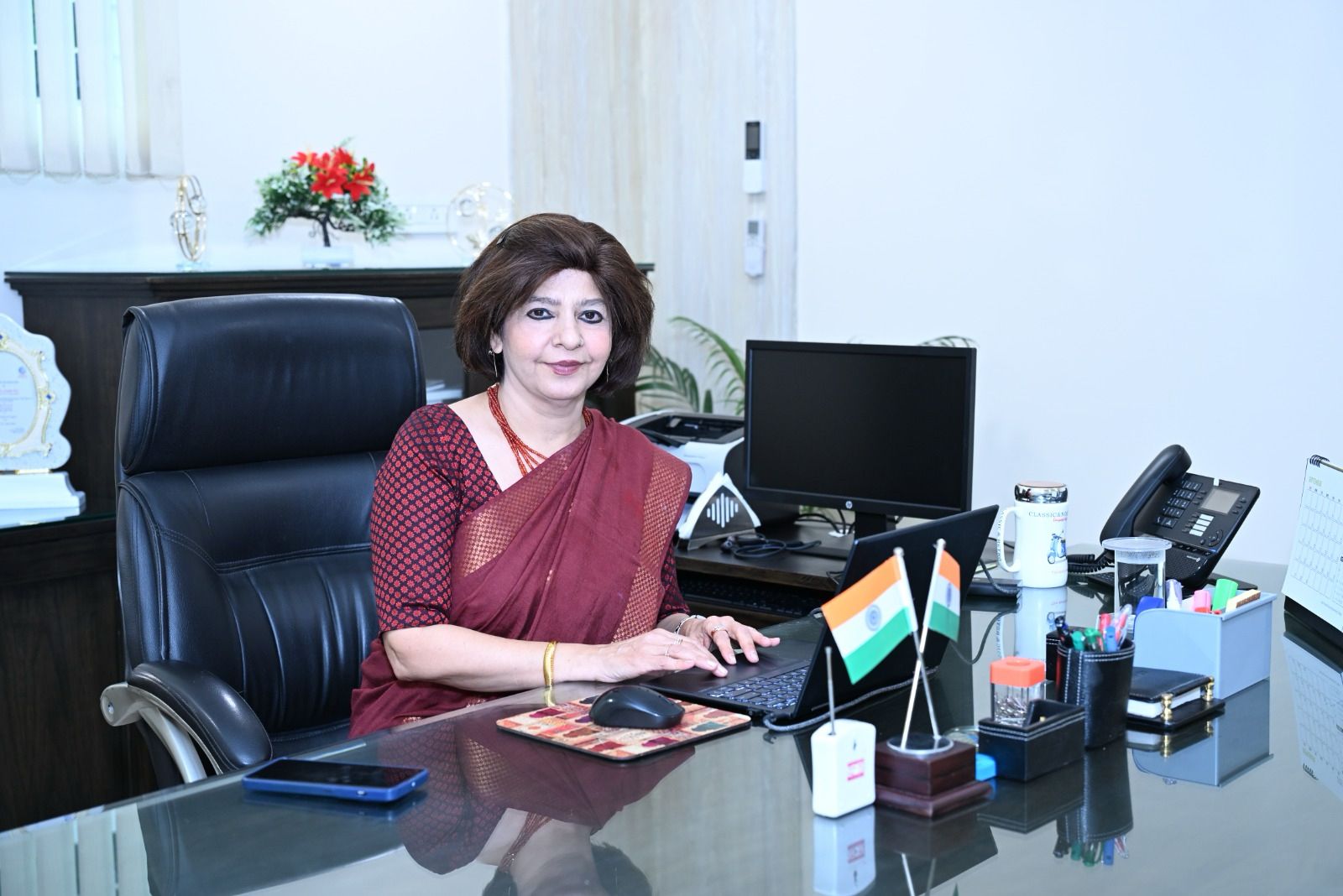

Dr Amita Dev
Advisor, AKGEC
Prof. Amita Dev is a distinguished Academician, Engineer, and Visionary leader with over 40 years of rich experience in Academia, Research, Industry, and Higher Education Administration. She is an Engineer with a Ph.D. in Computer Engineering.
She has held prestigious leadership roles including Vice Chancellor of Indira Gandhi Delhi Technical University for Women (IGDTUW) and Delhi Skill and Entrepreneurship University (DSEU), as well as Pro Vice Chancellor, Principal, and Head of Department at premier institutions. She is widely recognized for her excellence in Institutional Development, Policy Formulation, Research Leadership, and Innovation-Driven growth in Technical Education and Entrepreneurship.
Her research expertise spans Artificial Intelligence, Deep Neural Networks, Natural Language Processing. She has authored over 140 research publications, holds an impressive portfolio of 31 patents (20 granted), and has successfully led several Nationally funded projects exceeding ₹34 Crores from agencies such as DST, MeitY, AICTE, UKRI, and CFSL etc.
A sought-after speaker, mentor, and motivator, Prof. Dev has delivered thought-provoking lectures and keynote addresses at numerous national and international forums. Her outstanding contributions have been recognized with multiple National and International awards, including the AICTE Young Teacher Career Award, Best Engineering Teacher Award by ISTE, Lifetime Achievement Award by DMA, “Ambassador For Peace” by Universal Peace Federation, Shrimati Sushma Swaraj “STREE SHAKTI SAMMAN" Institution of Happiness Award by Hon’ble Minister of Women & Child Development , Vittiya Saksharta Abhiyan Award by Hon’ble Minister of Education and many more.
Prof. Amita Dev continues to inspire as a trailblazer in research, innovation, and academic leadership, with a vision to harness technology for education, empowerment, and societal progress.
Editorial Board Members:
Computer Science & Engineering/ information Technology:
Dr. Rajesh Prasad
Department of Computer Science and Engineering, Ajay Kumar Garg Engineering College, Ghaziabad, UP, India-201009
Email: [email protected]
Profile Link: https://www.akgec.ac.in/wp-content/uploads/2023/04/Dr.-Rajesh-Prasad.pdf
Prof. (Dr.) Abhay Bansal
Professor and Dean
Bennett University
Email: [email protected]
Profile Link: https://www.bennett.edu.in/faculties/prof-dr-abhay-bansal/
Dr. Raju Pal
Gautam Buddha University, Greater Noida
Email: [email protected]
Profile Link: https://faculty.gbu.ac.in/profile.php?id=rvlp2iTWiT5mZBgsaatHPxrEFrtg-6l4_s1knBj7WC0
Prof. Rama Shankar Yadav
Professor
Department of Computer Science & Engineering
Motilal Nehru National Institute of Technology Allahabad, Prayagraj, India-211004
E-mail: [email protected]
Telephone: 0532-2271355(O) 0532-2271667(R) 9451373879(M)
Profile Link: https://mnnit.ac.in/profile/rsy
Dr. Ranvijay
Associate Professor
Department of Computer Science & Engineering
Motilal Nehru National Institute of Technology Allahabad, Prayagraj, India-211004
E-mail: [email protected]
Telephone: 05322271368(O) 9695167607(M)
Profile Link: https://www.mnnit.ac.in/profile/ranvijay Dr. Ranvijay
Dr. Sarsij Tripathi
Associate Professor
Department of Computer Science & Engineering
Motilal Nehru National Institute of Technology Allahabad, Prayagraj, India-211004
E-mail: [email protected]
Profile Link: https://mnnit.ac.in/profile/sarsij SARSIJ TRIPATHI
Prof. (Dr.) Divakar Yadav
Professor
Department/School: School of Computer and Information Science (SOCIS), IGNOU, NEW
Delhi-110068
Email ID: [email protected], [email protected], [email protected]
Office Address: Room No.121, Block-C, SOCIS, Academic Complex, IGNOU, Maidan Garhi, New
Delhi – 110068
Profile Link: https://www.ignou.ac.in/viewFile/SOCIS/profile/DivakarYadav.pdf
Dr. Vinish Kumar
Professor and HEad
Raj Kumar Goel Institute of Technology,
Email: [email protected]
Profile link: https://scholar.google.com/citations?user=yhd5xq8AAAAJ&hl=en&oi=ao
Electronics and Communication Engineering/ Electrical Engineering:
Dr. Omveer Singh
Associate Professor
Gautam Buddha University, Greater Noida
Email: [email protected]
Profile Link: https://faculty.gbu.ac.in/profile.php?id=qAuF1hl0WK4VSPJ13u-gwiMmWM0lltC0vu0nxUDRZ8c
Prof. (Dr.) Priyanka Jain
Professor
Delhi Technical University, Delhi
Email: [email protected]
Profile Link: https://dtu.ac.in/modules/facilities/people/faculty/view.php?uname=priyankajain
Prof. (Dr.) Neeta Pandey
Professor
Delhi Technical University ,Delhi
Email: [email protected]
Profile Link: https://www.dtu.ac.in/Web/Departments/Electronics/faculty/neetapandey.php
Applied Science and Humanities
Prof. (Dr.) Mangey Ram
Professor (Research) & Dean (Research Collaborations)
Graphic Era Deemed to be University, Dehradun, 248002, India
Email: [email protected]
Profile Link: https://geu.ac.in/about-us/distinguished-faculty/prof-dr-mangey-ram/
Mechanical Engineering:
Name: Dr. Dan Sathiaraj
Department: Mechanical Engineering
Designation: Associate Professor
University: IIT Indore
Email ID: [email protected]
Area of Interest: High Entropy Alloys, Bulk nanostructured materials, Thermo-mechanical processing, microstructure and texture
Google Scholar: https://scholar.google.com/citations?user=BspF8ZwAAAAJ&hl=en
Name: Dr. Harish Kumar
Department: Mechanical & Aerospace Engineering
Designation: Associate Professor
University: National Institute of Technology, Delhi
Email ID: [email protected]
Area of Interest: Additive manufacturing, Sensors and transducers, Measurement uncertainty, Advanced machining
Google Scholar: https://scholar.google.com/citations?user=VgdCfhIAAAAJ&hl=en
Name: Dr. Tameshwer Nath
Department: Department of Mechatronics Engineering,
Designation: Assistant Professor
University: Indian Institute of Information Technology Bhagalpur Sabour, Bhagalpur-813210
Email ID: [email protected]
Area of Interest: Smart Material, Control of structures, MEMS, Mechatronics
Google Scholar: https://scholar.google.com/citations?user=ChZpZpgAAAAJ&hl=en
Name: Dr. Mohit Tayagi
Department: Production and Industrial Engineering
Designation: Associate Professor
University: Punjab Engineering College, (Deemed to be University), Chandigarh
Email ID: [email protected]
Area of Interest: Industrial Engineering, Supply Chain Performance System, Decision Science, System Optimization CSR
Google Scholar: https://scholar.google.com/citations?user=zx2K5fsAAAAJ&hl=en
Prof.(Dr.) Sanjeev Kumar
Designation: Professor
Email Id: [email protected]
Department: Mechanical Engineering,
University: J.C. Bose University of Science and Technology, YMCA
Specialization: Industrial Engineering, Stochastic Modelling, Metal Metrix Composites, Quality Management
https://scholar.google.com/citations?user=KqsehoEAAAAJ&hl=en
Dr. Vasdev Malhotra
Designation: Professor
Email Id: [email protected]
Department: Mechanical Engineering,
University: YMCA University of Science and Technology,Faridabad
Area of Interest: Advanced Manufacturing
https://scholar.google.com/citations?user=dGRzkoIAAAAJ&hl=en
Dr. Ashiwani Kumar
Designation: Assistant professor
College: Feroze Gandhi Institute of Technology , Raebareli
Email Id: [email protected]
Area of Interest: composite material, Tribology, Bond theory, Manufacturing
https://scholar.google.com/citations?user=mXI3-YgAAAAJ&hl=en
Name: Dr. Anubhav Rawat
Department: Department of Applied Mechanics
Designation: Assistant Professor
University: Motilal Nehru National Institute of Technology Allahabad, Prayagraj, India-211004
Email ID: [email protected]
Area of Interest: Multiphase Flows, CFD, Fluid Mechanics, Complex Fluids, Machine Learning
Energy and its Optimization
Google Scholar ID:- https://scholar.google.com/citations?user=svrbtdcAAAAJ&hl=en
Name: Dr. Pritanshu Ranjan
Department: Mechanical Engineering Department,
Designation: Assistant Professor
University: BITS Pilani, Goa Campus
Email ID: [email protected]
Area of Interest: CFD, PANS, Heat Transfer, Turbulence
Google Scholar ID: https://scholar.google.co.in/citations?user=OZcmms4AAAAJ&hl=en
Name: Dr. Anuj Kumar Shukla
Department: Mechanical Engineering Department,
Designation: Assistant Professor
University: NIT Raipur
Email ID: [email protected]
Area of Interest: CFD, Heat Transfer, Turbulence, Mechanical Engineering, Fluid Mechanics
Google Scholar ID: https://scholar.google.com/citations?user=KW_gR8QAAAAJ&hl=en
The aim of AKGEC International Journal of Technology is to disseminate original, scientific, theoretical or applied research in the field of Engineering, Technology and Applied Science. Papers reporting original research and innovative applications from all parts of the world are welcome. Papers for publication in the journal are selected through rigorous peer review, to ensure originality, timeliness, relevance, and readability. While the journal emphasizes the publication of previously unpublished articles, selected extended conference papers with exceptional merit are also considered. The journal also seeks clearly written survey and review articles from experts in the field, to promote insightful understanding of the state-of-the-art and technology trends.
AKGEC Journal Of Technology publishes original papers that cover, but are not limited to, the following areas:
• Electrical Engineering,
• Power Engineering,
• Mechanical Engineering,
• Automation and Control,
• Measurement and Metrology,
• Signal Processing,
• Telecommunications,
• Civil Engineering,
• Chemical Engineering,
• Materials Science,
• Computer Engineering,
• Information Technology and Informatics,
• Data Engineering and Software Engineering
Invitation for Manuscripts concerning engineering subjects for publication in the AKG International Journal of Technology
The “AKG International Journal of Technology” i.e. AKGIJT is a peer-reviewed journal published by Ajay Kumar Garg Engineering College (AKGEC). The AKGEC is among the top rung technical institutions situated in the Nationals Capital Region of India in Ghaziabad. The AKGEC is committed to provide world class education and research in the cutting-edge areas and has developed industry scale innovation centres in the frontline technologies. The Institute’s modern infrastructure attracts the industry to supplement training and research. The AKGIJT lives up to the vision of AKGEC and publishes peer review articles in the broad areas of Engineering & Technology involving all major disciplines for the last 13 years. The Journal has so far successfully published 14 biannual volumes and archived all the issues online with free accessibility in pdf format.
The AKGIJT invites scientific articles, original research, state of the art reviews and case studies from the industry, research and academic professionals for consideration of publication in this open access (without APC) journal. The submitted articles will be peer-reviewed and further consideration will follow the review report/recommendations. Submissions will be peer-reviewed by a panel of experts.
Contributions in the broader contemporary research involving broad engineering disciplines and multi-disciplinary areas are welcomed.
Brief submission guidelines are given below, but the prospective authors are encouraged to visit the Journal's website
Submission guidelines:
Authors can format their paper as per the IEEE template available at Template
Submit manuscript: Email your manuscript to this email-id: [email protected]
Before you submit your manuscript, please make sure it is properly formatted for the journal. What follows is a basic checklist; additional requirements can be found in the sections that follow.
1. Your manuscript should be submitted in either Word or LaTeX format. If the manuscript is submitted as a LaTeX file, upload a PDF version of the manuscript as supplemental material.
2. The affiliation information for all authors must be listed on the title page; the corresponding author must be identified, and that author’s email address must be provided.
3. An abstract of 150–250 words and 4 to 6 keywords must be included.
4. All lines should be double spaced.
5. Page numbers are required and should be inserted in the manuscript. Including line numbers is preferred but optional.
6. Abbreviations must be defined on first use in the abstract and then redefined again in the body of the manuscript using this style: molecular beam epitaxy (MBE).
7. Variables must be italicized in the equations and in the text.
8. Equations must be numbered in order to the right of the equation with the number in parentheses: (1), (2), etc.
9. SI units of time are required: Use (h) for hours, (min) for minutes, and (s) for seconds.
10. Torr units should be converted to kPa.
11. References must be in the style of the journal with all author names cited (et al. is not permitted), journal article titles included, and journal titles correctly abbreviated.
12. All tables and figures must be numbered and cited in numerical ascending order in the text. Roman numerals (i.e., I, II) are used for table numbers, and Arabic numbers (i.e., 1, 2) are used for figure numbers.
13. Figures must be uploaded as separate high-resolution files and embedded in the manuscript file where they are discussed. Tables should be included within the manuscript file. Uploading tables as separate source files (.doc, LaTeX, or .xls format) is optional.
14. If any figures and/or tables are being reprinted or modified from another source, it must be noted in the caption(s) and proof of permission must be uploaded.
15. Multi-part figures should be labeled as (a), (b), (c), etc., and a brief description of each figure part must be provided in the figure caption.
16. Micrographs must have scale markers that will be readable in a printed journal. Place scale markers and units on micrographs in a white box within the image using a thicker line for the scale and a larger font size used for the units for better readability.
17. Color figures must be understandable if printed in black and white. (If you have used color figures, they will be printed in in black and white in the print issue and appear in color online, so be sure they will convey the needed information without the use of color. Various types of lines [dash, dotted, long dash, etc.] and/or symbols can be used to delineate differences in addition to colors.)
18. If an appendix is part of the article, place it at the end of the manuscript text before the reference list.
Title Page
The title page should include:
* A concise and informative title, with correct capitalization of chemical symbols
* The name(s) of the author(s)
* The affiliation(s) and address(es) of the author(s)
* The e-mail address of the corresponding author
Abstract
Provide an abstract of 150 to 250 words. The abstract should be one paragraph and should not contain any undefined abbreviations or any reference citations.
Keywords
Provide 4 to 6 keywords that can be used for indexing purposes. These keywords should be added after the Abstract.
MANUSCRIPT FORMATTING
* Manuscripts should be submitted in Microsoft Word or LaTeX format.
* Use double column, double line spacing
* Use a normal, plain font (e.g., 10-point Times Roman) for text.
* Use italics for variables and equations (e.g., ZT, p-type, n-type).
* It is required that the manuscript displays page numbers. The journal recommends that authors use the automatic page numbering function to number the pages; automatic line numbering is preferred but optional.
* Use the table function, not spreadsheets, to make tables. Upload your tables as separate document files.
* Scientific notation should be set as 1 x 10 with a superscript -7 as opposed to the computer programming style of 1E-7.
Headings
Use no more than three levels of displayed headings.
Abbreviations
Abbreviations should be defined at first mention, in the abstract and again in the body of the manuscript using this style—molecular beam epitaxy (MBE)—and used consistently thereafter. Even commonly known abbreviations should be defined.
Acknowledgments
Acknowledgments of people, grants, funds, etc. should be placed in a separate section before the reference list. The names of funding organizations should be written in full.
Citations
Reference citations in the text should be identified by numbers in square brackets and should appear in ascending numerical order. Some examples:
* Negotiation research spans many disciplines [3].This result was later contradicted by Becker and Seligman [5].
* This effect has been studied widely [1-3, 7].
Tables
* Tables should be included within the manuscript file. Uploading tables as separate source files (.doc, LaTeX, or .xls format) is optional.
* All tables should be numbered using Roman numerals.
* Tables should always be cited in the text in consecutive numerical order.
* For each table, supply a caption (title) explaining the components of the table.
* Identify any previously published material by giving the original source in the form of a reference at the end of the table caption.
* Footnotes to tables should be indicated by superscript lower-case letters (or asterisks for significance values and other statistical data) and included beneath the table body.
Figure Submission
* Supply all figures as separate high-resolution files and also embed the figures in the manuscript file where they are discussed. The captions should be in the manuscript file and should not be part of the image.
* For vector graphics, the preferred format is EPS; for halftones, TIFF format is recommended. Vector graphics containing fonts must have the fonts embedded in the files.
* Name your figure files with “Fig" and the figure number, e.g., Fig1.eps.
Micrographs
All micrographs must have scale markers. Scale markers and units on micrographs should be placed in a white box within the image using a thicker line for the scale and a larger font size used for the units for better readability.
Online Submission
Step 1
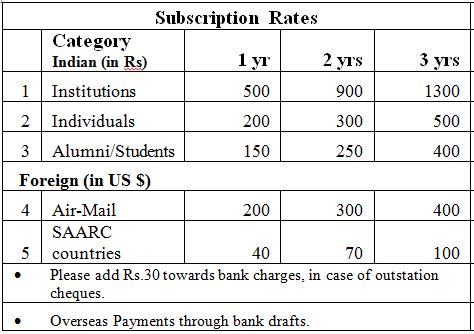
Choose your Subscription
Step 2
Online Payment : Through RTGS/NEFT
| Name of the Beneficiary | Ajay Kumar Garg Engineering College |
| Name of the Bank | Kotak Mahindra Bank Ltd |
| Branch Address | 30 & 31 Navyug Market, P.B.No. 75 Ghaziabad-201001 (U.P.) -INDIA |
| Branch Code | 5295 |
| Bank Account No. | 508010250461 |
| Type of Bank Account | Saving Bank Account |
| RTGS/NEFT/IFSC Code | KKBK0005295 |
| Contact No. | 0120-2790969 |
Offline Payment : Through Bank Draft/Cheque
All Cheques / Demand Drafts (DD) should be made in favour of “Ajay Kumar Garg Engineering College.", payable at Ghaziabad.
Step 3
Click “Fill details online" link.
Step 4
Fill the required details in the form and submit.
Journal January - June 2026
Journal July - December 2025
Journal January - June 2025
Journal July - December 2024
Journal January - June 2024
Journal July - December 2023
Journal January - June 2023
Journal July - December 2022
| AKGEC International Journal of Technology | |
| July – December 2022 Vol. 13, No.2 | |
| S No. | Content |
| 1 | Block-chain and Future Communication based Decentralised Train Control System Dr. Satya N. Gupta |
| 2 | Digital Transformation – the Frontier of Evolution Tilak Raj Dua |
| 3 | Parents’ Perceptions towards Learning of Their Children during Covid 19 Dr. Neha Vashistha |
| 4 | Dual Channel Transmitter for Medium Range Secondary Surveillance Radar Amit Tiwari |
| 5 | Work-Life Balance in the Shadow of the Pandemic- with Due Consideration to IT Companies Aashish Dhiman |
| 6 | Disposable Dispenser-Cum-Extruder Units for 3D Printers to Use with Wet Mix Materials Dr. K Kamal |
| 7 | Impact of Covid 19 on Physical and Mental Health with Special Reference to Healthcare Personnel Sneha Dhiman |
| 8 | Phygital is the New Normal Dr. Ranjit Singh |
| 9 | Chain-Necklace Diagrams with the Sum of Two Consecutive Numbers a Perfect Cube Dr. Tejmal Rathore |
| 10 | ISRO’s NAVIC: Navigation Support to Civil and Military Segments Dr. Ranjit Singh |
Journal January - June 2022
Journal July - December 2021
Journal January - June 2021
| AKGEC International Journal of Technology | |
| January – June 2021 Vol. 12, No.1 | |
| S No. | Content |
| 1 | Shared Digital Infrastructure for 5G-IoT Ready Smart Cities Tilak Raj Dua |
| 2 | Importance of Private 5G Spectrum for Industrial Development of IndiaBharat_Bhatia |
| 3 | Voltage and Current Mode Filter Realizations using Active Devices Dr. T. S. Rathore |
| 4 | A Simulation of Night Vision Technology Aided with AI Amit Tiwari |
| 5 | Case for Wi-Max Technology Dr. Neelesh Kumar Gupta |
| 6 | Trade Secret as Intellectual Property Strategic Tool in Industry 4.0 Prity Khastgir |
| 7 | Design and Fabrication of a Prototype Electric Vehicle Arun Kumar Maurya |
| 8 | Gauging Job Satisfaction in the Indian Oil and Gas Sector Dr Sheetal Khanka and Akhil Damodaran |
| 9 | Implementation of Crime Patterns Prediction Using Data Mining Sudha Rani and Shweta Roy |
| 10 | Advent of the Data Centre Era Dr. Ranjit Singh |
Journal July - December 2020
Journal January - June 2020
| AKGEC International Journal of Technology | |
| January – June 2020 Vol. 11, No.1 ISSN 0975-9514 | |
| S No. | Content |
| 1 | Mobile Edge Computing In 5G Era Manjit Singh |
| 2 | Innovations- Sustainability of Telecom Tilak Raj Dua |
| 3 | Managing New Internet (IPv6) in Country – Case for a 22 National Root Server for v6 Satya N. Gupta and Keshav Sharma |
| 4 | General Data Protection Regulation and Its 28 Impact on Indian Enterprises Dr. Brijesh Kumar Gupta |
| 5 | Soil Nailing for Highway Construction Archita Goyal and A. K. Shrivastava |
| 6 | Power Balance ICP Model Dr. Bhupal Singh, Dr. K.B. Sahay and Dr. Sneh Anand |
| 7 | Plastics Addiction: Humanity’s Existential Crisis Pratibha Singh and Om Pal Singh |
| 8 | Transmitter for Beam Forming Applications Amit Tiwari |
| 9 | Deep Learning Algorithms to Improve Financial Decisions Shweta Roy |
| 10 | Symbiosis of Electronics and Mechanical Engineering Dr. Ranjit Singh |
Journal July - December 2019
Journal January - June 2019
Journal July- December 2018
Journal January - June 2018
Journal July-Dec 2017
AKGEC 8.2 Journal (July-December 2017)
Journal Jan-June 2017
AKGEC 8.1 Journal (Jan-June 2017)
Journal July-Dec 2016
AKGEC 7.2 Journal (Jul-Dec 2016)
Journal Jan-Jun 2016
AKGEC 7.1 Journal (Jan-June 2016)
Journal July-Dec 2015
AKGEC 6.2 Journal (Jul-Dec 2015)
Journal Jan-Jun 2015
AKGEC 6.1 Journal (Jan-June 2015)
Journal July-Dec 2014
Journal Jan-June 2014
Journal July-Dec 2013
Journal Jan-Jun 2013
Journal July-Dec 2012
Journal Jan-June 2012
Journal July-Dec 2011
Journal Jan-Jun 2011
Journal Jan-Jun 2010
Journal July-Dec 2010
Editor-in-chief
Dr. Rajesh Prasad
Professor
Ajay Kumar Garg Engineering College, Ghaziabad, UP, India-201015
Email: [email protected]
Mobile No: +919667896459
Publisher
Ajay Kumar Garg Engineering College, 27th KM Milestone, Delhi – Meerut Expy,
Ghaziabad-201015, Uttar Pradesh
Email: [email protected]
Mobile No: +917290034978